
From a research question to an appraised evidence base
Five steps, with you in control throughout. Aibstracts searches, screens, and proposes source-linked judgments. You review every call and retain the complete decision trail.
Protocol
Start from a question, not a blank template.
- Describe the review in plain language and get a drafted protocol back
- Population, intervention, comparator, outcomes and eligibility criteria, written for you
- A Boolean search strategy with MeSH hints, ready to run
- PECO, SPIDER and other frameworks where they fit the question better
- Edit anything, lock it when you are ready
- Every version saved, so the protocol stays auditable as it changes
Search
Find the relevant work without the noise.
- Six sources, including PubMed, the Cochrane Database of Systematic Reviews, trial registries and grey literature
- Five routes at once: the database search, citations forward and backward, similar-paper recommendations, your own uploads
- One strategy written once, compiled into each database’s own query language
- Duplicates collapsed, and every record keeps the lane it arrived through
- Predatory journals flagged for your call, never quietly dropped
Screening
Spend reviewer time on judgment, not triage.
- Every record scored on six weighted dimensions: relevance, evidence value, extractability, influence, credibility, timeliness
- Explicit penalties for off-topic, editorial, or flagged-venue records
- Study design classified, and each study routed on it
- Include, uncertain or exclude with a reason, at both title and abstract and full text
- You confirm or override, and the trail records who decided what and why
Appraisal
The hardest, slowest part of the review, handled.
- RoB 2 for randomized trials, in its parallel, cluster and crossover forms
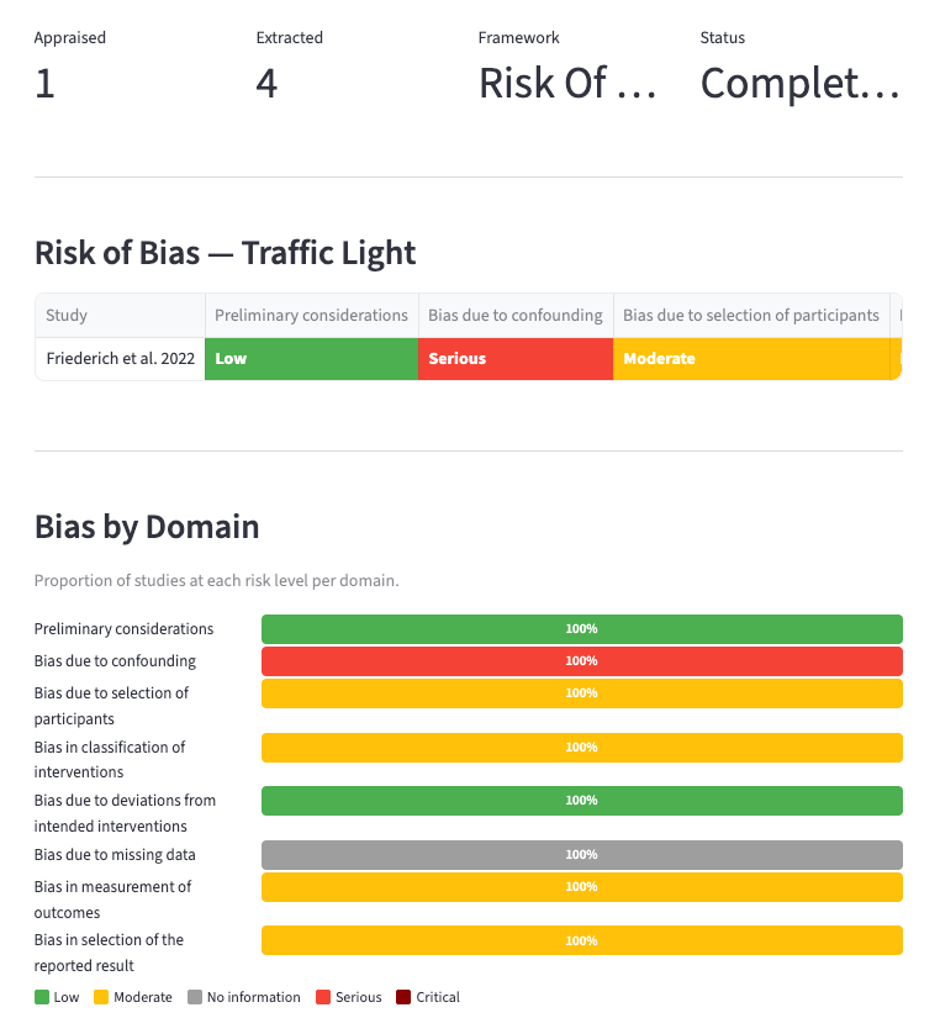
- ROBINS-I for non-randomized studies of interventions
- Every signalling answer anchored to a quote from the source PDF
- Domain and overall judgments from the published algorithms, run as deterministic code
- Studies that fit neither framework get a structured Evidence Profile, never dropped
Verify
Sign off with confidence, and prove it.
- Override any signalling answer and the judgments recompute on the spot
- Reconciliation flags where a full-text reading disagrees with the abstract-stage call
- Re-run a review you finished by hand and compare the appraisals study by study
- A verified, structured, exportable evidence base, ready to synthesize
Six sources, five ways in, one deduplicated record set
A corpus size tells you what could be found. What decides whether a study actually surfaces is which databases are asked and how many routes lead to it, so the search runs six sources down five routes at once and merges the result.
- 01
Database search
Your Boolean strategy, compiled into each database’s own query language.
- 02
Forward citations
Papers that went on to cite a study you already included.
- 03
Backward citations
The reference list behind every included study, followed up.
- 04
Similar-paper recommendations
Close neighbours in the citation graph that a query can miss.
- 05
Reviewer-added
The papers your team uploads, or already knew had to be in.
Duplicates are collapsed across all five lanes, and every record keeps the lane it arrived through. That is why the PRISMA counts come off the trail itself instead of being reconstructed at the end.
We have not measured recall against a gold-standard reference set, so we will not call this search comprehensive. Some databases are not connected at all. If your protocol names one we do not cover, that is worth knowing before you start rather than after, so what the search does and does not reach is set out in the FAQ.
What the search does and does not cover → What we have measured, and every miss →
See it on your own review
Bring a real question. The fastest way to judge the workflow is to run one.
Thirty minutes with the founder, no sales qualification call first